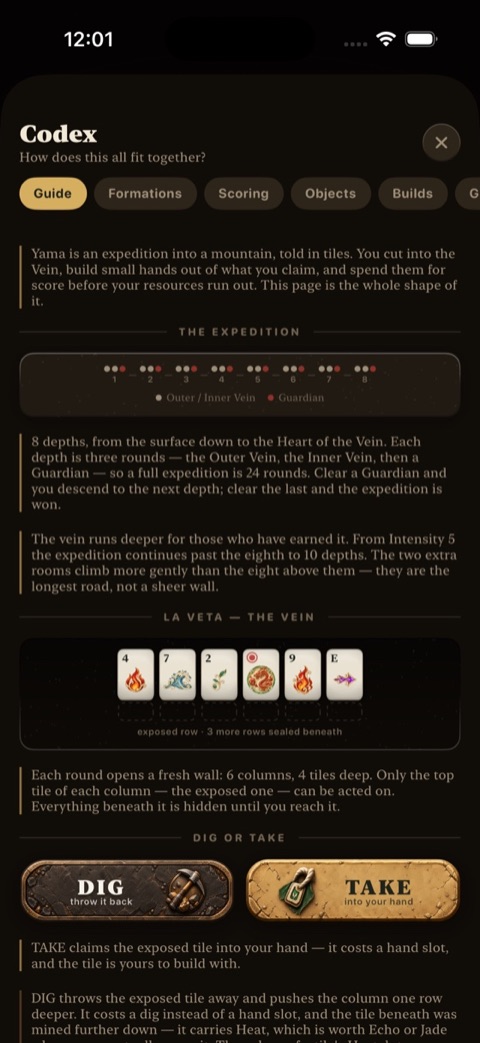
You never draw a tile.You dig it out of the mountain.
Yama is a game about going down. Every round lays out a wall of mahjong tiles six columns across and four deep, face up. You choose which ones to take, which to throw away to reach what is underneath, and what to build with the ones you keep. Get enough points and you go one depth deeper.
The short version
Mahjong's tiles and its rules. Poker's hands. A wall you dig into.
From mahjong
The tiles, and what a round can ask of a hand.
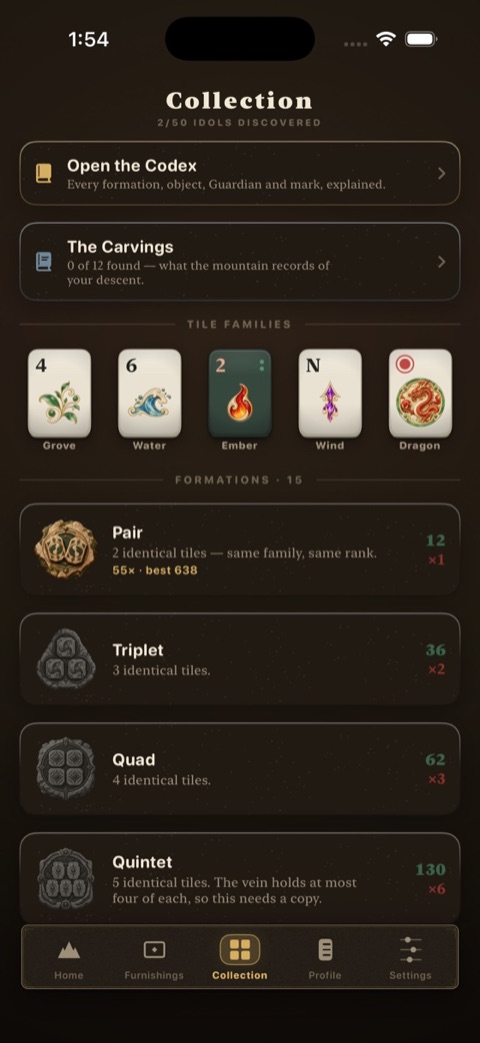
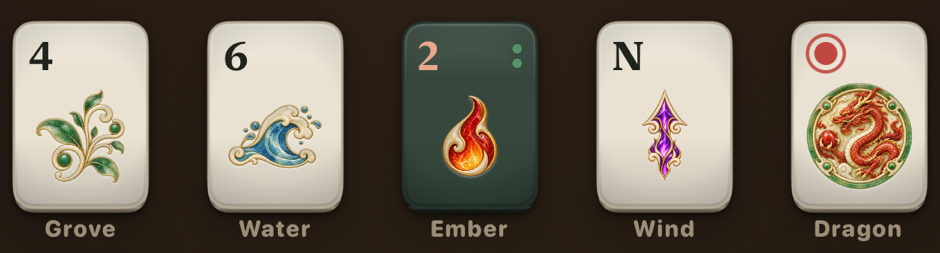
Five families. Three run 1 to 9 — Grove, Water and Ember — and two have no numbers at all: the Winds and the Dragons, the scarcest and most valuable things on the wall. Anyone who has ever seen a mahjong tile will recognise every one of them. And so are the rules a round lays down over the top of them, which is the half people miss.
From poker
What you do with them.
You hold a hand and spend part of it on a ranked shape — a pair, three of a kind, a run of numbers, a full house. The better shapes are worth more and are harder to put together, and knowing when to cash a small one instead of holding out for a big one is most of the skill.
Yama's own
Where the tiles come from.
In mahjong you draw blind. In poker you are dealt. Here the wall stands in front of you six columns wide, its top row face up, and you decide what to take and what to throw away to open what is under it. That is the whole game, and it is the part neither of the two it comes from has.
Poker ranks a hand and stops there: a full house beats a flush and that is the end of the conversation. Mahjong has always done something else as well — hands that only count if every tile in them shares some property. All of one family. No honour tiles anywhere. Every tile green.
Yama takes that idea straight, and it is where most of a round's character comes from. A round can seal a family, so nothing in that colour scores at all. It can bar the Winds and Dragons — the exact tiles you have spent the run collecting. It can require that every numbered tile you play is even. It can insist that repetitions and sequences alternate, or that each hand scores more than the one before it. Thirty-five of these exist across three kinds, and a round draws between one and three of them at once, which is why the same wall is a different problem the second time you meet it.
It saves after every round. A run does not have to be finished in one sitting, or even in one day — you can put it down mid-round and it is exactly where you left it. Fifteen minutes is a real amount of Yama.
Three rounds, unedited
Recorded off the phone, with nothing added.
No captions, no cuts, no music laid over the top. This is what the game looks like in the hand.
Depth 1 · The two things you do
Only the top row is open.
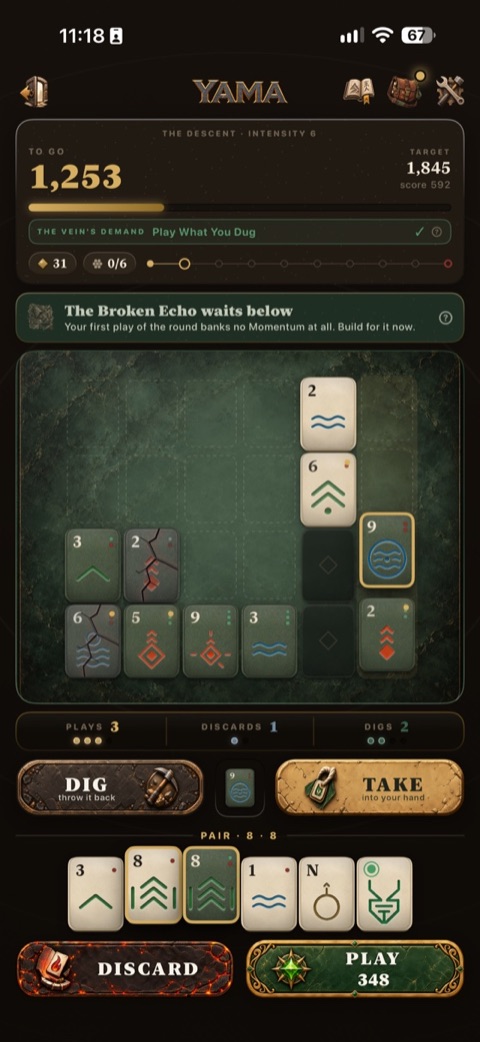
In most card games you shuffle, draw and hope. Here the tiles are already on the table, in six columns four deep. The top of each column is face up; what is under it is not — and turning the next one over is a move you have to pay for.
So you are never guessing at a shuffle. You are choosing between six tiles you can see, and deciding which column is worth opening to find the seventh.
TAKE
Puts the uncovered tile in your hand, and turns over the one beneath it. Your hand only holds so many, so every tile you take is a slot you no longer have.
DIG
Throws the uncovered tile away and moves that column one row deeper. You only get a few digs a round — and what comes up was buried further down, so it is worth more.
Tiles from deeper down arrive hot, and the coloured dots on a tile say how much they are worth and in which of the two currencies. But the deeper you dig the likelier a tile comes up cracked — and a cracked tile costs you instead of paying you. Empty a whole column and the mountain pays a bonus.
So the wall stops being luck you put up with and becomes something you read: which columns you have opened, what you have thrown away to open them, how much is worth taking, and how close to the bad stuff you are standing.
Depth 2 · Scoring
Two numbers, multiplied.
You spend two to five tiles from your hand on a shape — a pair, three of a kind, a run of numbers, five of one family. There are fifteen of them.
(Jade + tiles) × (Echo + Momentum)
Which is why the best round is not one huge play. Open with a pair to bank the Momentum, and the big shape at the end is multiplied by everything the small ones put in the bank.
What each shape is worth
Jade × Echo, before anything you have collectedThree tiles can beat four: a Dragon Triad is worth more than a Quad because dragons and winds are the scarcest tiles on the wall. Everything you collect over a run multiplies these, so by the bottom a good hand is worth thousands.
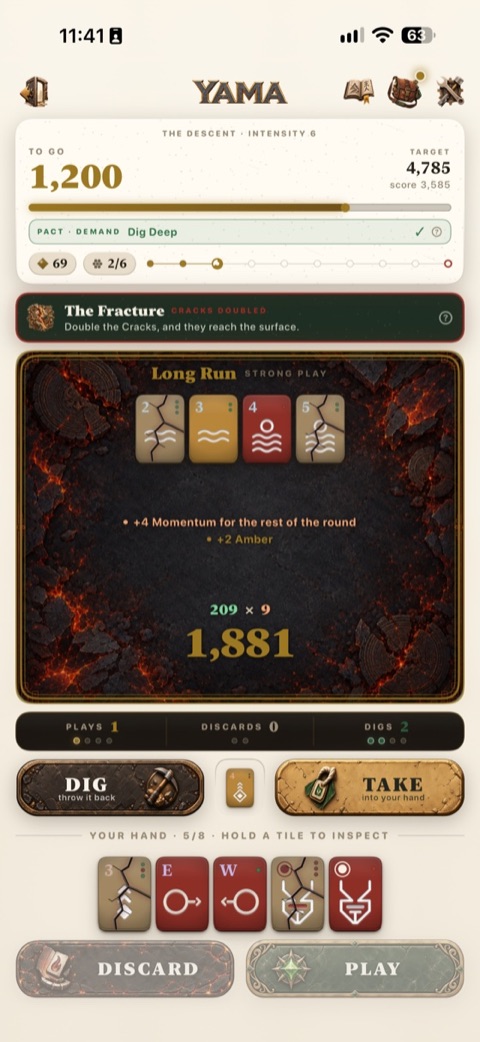
The conditions a round lays down come in three kinds, and what separates them is when they are checked. A Demand is measured at the end of the round — score with three different shapes, say. An Oath binds only your opening play, so the cost of breaking it is paid once and early. A Law is re-checked on every play you make, and it is the kind that turns a round into a different puzzle.
None of them stop you from playing. A hand that breaks one is still legal, still resolves, and still costs you the play — it simply scores nothing. They change what playing well looks like, not what is allowed.
Depth 3 · What makes it its own game
Two ideas the rest of it is built on.
You can see what you are digging into.
Getting a good tile is normally the part of a card game you have the least control over. Here it is the part you have the most control over — you can see four rows down as a shape, and every dig is a real decision with a real price. Someone who reads the wall well pulls ahead of someone who does not inside a single round, which is exactly what you want a skill to do.
Your tiles are yours, and they stay marked.
A run has a pool of real tiles, not a shuffled deck. The merchant between rounds sells marks you put on one specific tile — gild it, temper it, bless it, seal it — and it keeps that mark for the rest of the run. You meet that tile again. You dig for it. A sealed 5 of Ember becomes a thing you own in a way a card in a shuffled deck never quite is.
Depth 4 · Making it yours
The same board, your way.
Same wall, same opponent, same target of 8,935, same hand. Only the artwork changes. Thirteen tile sets and thirteen boards, all earned by playing.
Every one of them keeps the number in the same corner, in the same ink, at the same size. A tile set can change anything except how fast you can read a tile.
Depth 5 · Guardians
Twenty-two of them, and each one changes what the right move is.
A boss that simply halves your score is one you beat by playing exactly as before and taking a bit longer. It changes a number, not a decision.
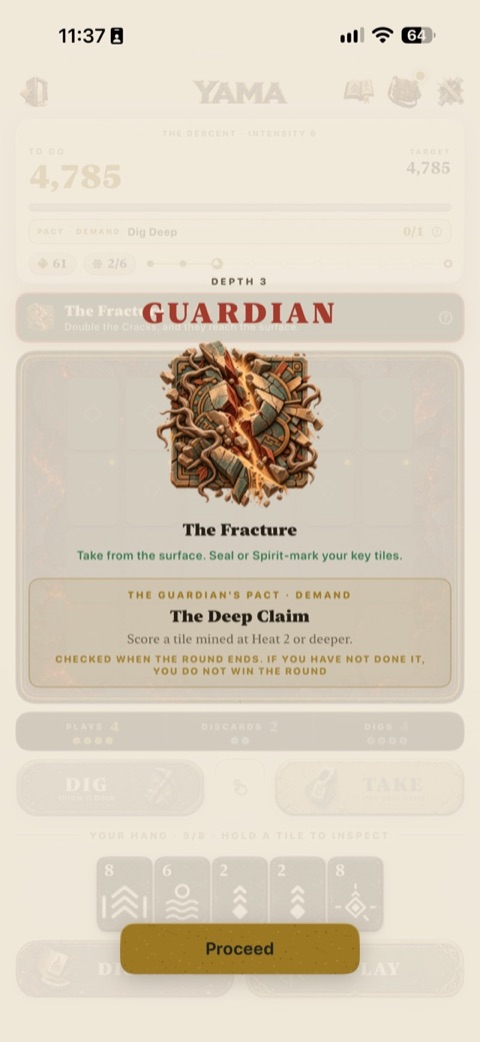
These do something else. The Shadow follows whichever family your hand is filling up with. The Spent Seam turns a second family against you and makes dry tiles cost you. The Forgetting takes the points away from whatever shape you have leaned on all game, and hands you an extra play and an extra discard to go and find a different one. None of them stop you from playing — all of them change what you should play. Each has its own painted seal and its own board.





















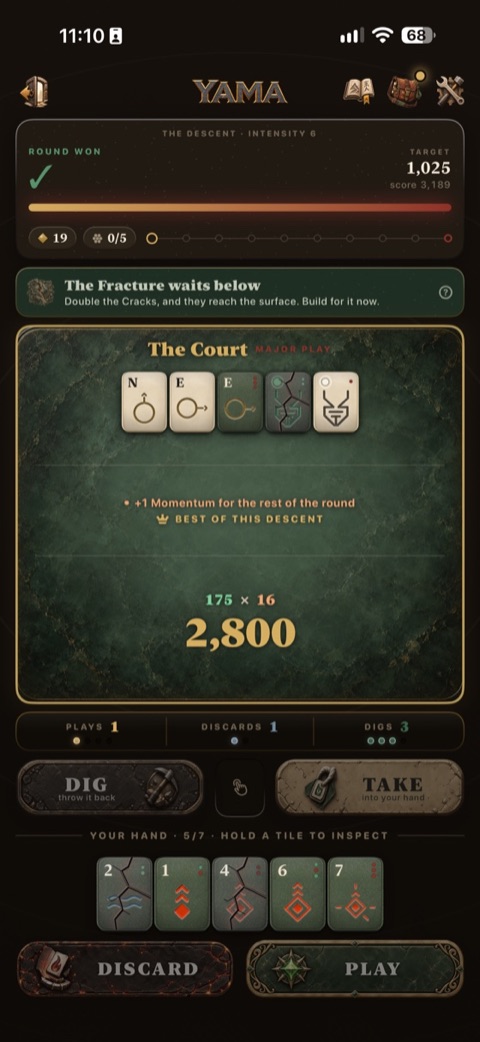
Depth 6 · Four ways down
And the last one has no bottom.
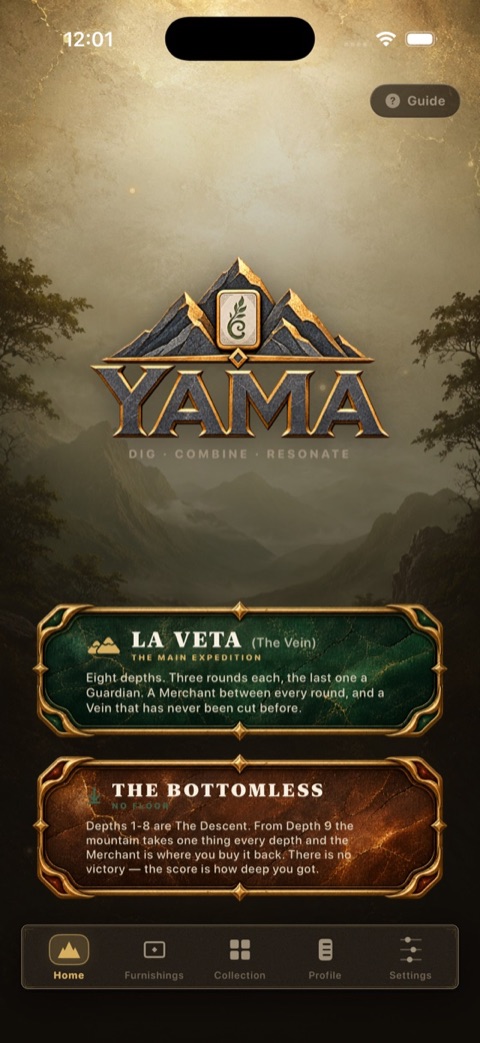
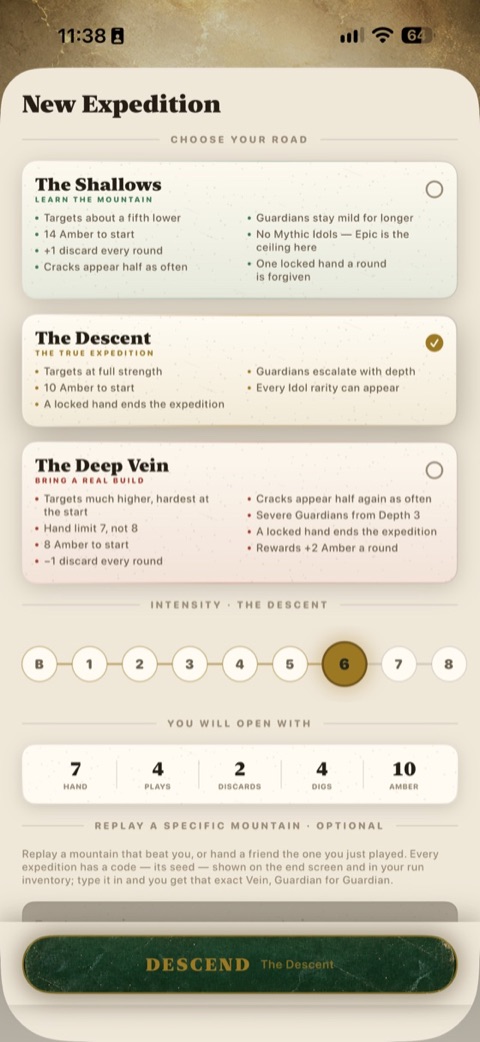
The Shallows teaches you. The Descent is the game as it is meant to be played. The Deep Vein is hardest at the start and expects you to know what you are doing. And then there is The Bottomless, which replays those eight depths and simply does not stop.
Past Depth 8 the mountain starts taking tiles out of the wall and never gives them back, and every few depths it adds a rule instead of just a bigger number. There is no winning it. The score is how deep you got.
each depth
round asks for
Guardian owns
Guardian
Three at once is the maximum that can exist together: one checked at the end of the round, one on your opening play, one on every play. And from Depth 33 the three rounds of a depth are three different Guardians. Every rung lands on a named depth rather than sliding up a curve, so a player can always point at what is making the run hard — and the game tells them which one is coming next.
Depth 24 · what one round actually looks like
The Forgetting Guardian
The shape you have leaned on most this whole run scores nothing. Here are two extra plays and an extra discard — go and find another one.
And the Vein asks for three more things at the same time.
Your best shape is dead, the tiles you spent the run collecting are worth nothing this round, you cannot open the way you normally would, and you still have to find three different shapes. Nothing there is illegal — every one of those plays still resolves. They just score nothing, and a play is a play.
Depth 9 · the first one past the bottom
A round you can plan.
- One thing asked of the round, on top of the points.
- A Guardian on the last of the three rounds. The other two are yours.
- One tile gone from the wall for good.
Depth 33 · and it keeps going
A round that asks for everything.
- Three things asked at once — one on your first play, one on every play, one on the round as a whole. That is as many as can exist together.
- A Guardian on all three rounds, and a different one each round.
- Five more tiles gone, out of a wall that has been shrinking since Depth 9.
The difficulty ladder on the other three roads works the same way. Turning it up does not just raise the number you are chasing — it takes a slot off your hand, lets rougher Guardians show up sooner, and past a point adds two extra depths to the whole run. The game writes out exactly what a setting costs on the screen where you pick it, so nobody is guessing.
Depth 7 · The fit
Why Arcade.
There is nothing to take out.
No in-app purchases, no ads, no analytics, no tracking, and no networking code of any kind — none of it was ever written. This is not a free-to-play game with the timers removed for the pitch. The only currency is one the game pays you at the end of a round and you spend at the merchant before the next one.
It works offline and keeps nothing.
No account, no sign-in, no consent screen, nothing collected. It runs on a plane.
There is a door for someone with fifteen minutes.
The Shallows exists to teach: gentler targets, more forgiving rules, and a card that says in plain words exactly what it changes. A round is a minute or two, the game saves after every one, and a first run can be finished on a couple of commutes. Nobody has to read anything to start.
And a long way down for anyone who wants one.
Twenty-two Guardians that each change what the right move is. A manual in the game that documents every shape, every Guardian and every step of the scoring. Difficulty settings that change the structure of a run rather than just the number you are chasing. Twelve pieces of story you unlock by descending. And a road with no bottom, for the people who want to find out where theirs is.
It is quiet.
A painted, still, unhurried game about a mountain. It is meant to be the thing you open when you want to think for a few minutes, and it looks like it.
15
Shapes
22
Guardians
50
Relics
30
Tools & offerings
4
Roads
13
Tile sets
13
Boards
12
Story pieces
29
Achievements
554
Tests
Depth 8 · How it was made
Played into shape.
Every number in this game has been moved because playing it said so. Not one of them was picked once and left alone.
The balance was rebuilt because the game kept being played.
One shape turned out to win rounds on its own, so it was pinned between the two it sits between and the round it used to finish now gets most of the way there. The system meant to make small hands worth playing was found to be quietly paying the big ones more — the exact opposite of the point of it — and was rewritten. A whole road was reopened and re-tuned after it turned out you could play it for twenty depths and never meet a wall, and then hit one all at once. None of that came out of a spreadsheet. It came out of playing to the bottom and not liking what happened.
And then checked against something that cannot be talked round.
Instinct about difficulty is unreliable in both directions — you are the person who knows every rule, and you have played the opening a thousand times more than anyone else ever will. So there is a tool in the project that plays real rounds through the real scoring code, and it is where an argument goes to be settled. It has killed ideas that felt right: one proposed fix was measured, shown to punish a new player exactly as hard as an experienced one, and dropped.
Every sound is made inside the project.
All the music and all the effects are generated by code we wrote — no libraries, no sample packs. One of the three pieces was written from a brief: bamboo flute and plucked zither over a low drone. The music is checked by measurement as well as by ear, because a loop can develop a click that you stop hearing after the fortieth time and a first-time player hears immediately.
Painted throughout, and it cannot fail quietly.
Twenty-two Guardian seals, fifty relics, thirteen tile sets, thirteen boards, twelve ranks and fourteen full-screen story paintings. If a piece of art were ever missing the game draws a fallback rather than a blank space — and a test checks the real artwork is in the build, so a missing file cannot ship unnoticed.
It teaches itself, in three parts.
A new player gets a short read-through before anything is at stake, then a tour of the real play screen with each part of it lit in turn, and then a guided first descent that hands the game over one move at a time. The first two can be stepped back through. The third cannot, deliberately — a tile you have taken cannot be un-taken, and a tutorial that pretended otherwise would be teaching the wrong lesson about the game it is teaching.
Built to be worked on.
About 41,000 lines of Swift and SwiftUI, iOS 17 and up, no third-party code at all, and 554 tests. The rules are kept deliberately separate from the interface, which is what lets them be tested on their own.